
The biggest AI SEO trends in 2026 are AI Overviews and AI Mode changing how clicks flow, E-E-A-T becoming central to visibility, generative engine optimisation (GEO) emerging as its own discipline, YouTube and video search growing, traditional SEO foundations staying essential, zero-click answers becoming the norm and search spreading across many platforms beyond Google. Brands that create genuinely expert, well-structured content and build visibility everywhere their audience searches will win.
Search is changing faster than at any point in its history. New features, platforms and behaviours appear every few months, and AI sits at the centre of almost all of them.
This guide reviews the most significant AI SEO trends shaping 2026, explains what they mean for your business and shows you how to respond. Whether you’re building an in-house team or working with an experienced AI SEO agency, the fundamentals below apply.
The Growing Influence of AI on Search
The search landscape is changing rapidly, and AI is at the forefront of it. Google’s AI Overviews now reach roughly two billion monthly users worldwide according to Google’s own reporting, fundamentally reshaping how people interact with search results. AI’s presence within the search engine has become so significant for SEO that keyword-stuffing tactics no longer produce results.
The result is a very different results page. Instead of ten blue links, users often see an AI-generated summary first, followed by ads, local results, videos and only then traditional listings. Old tactics such as keyword stuffing don’t work, because AI-powered systems understand meaning, context and quality far better than they once did.
To stay visible in 2026, you need a considered mix of AI awareness, smart content strategy and strong SEO fundamentals.
7 AI SEO Trends to Watch in 2026
As ever in the fast-moving world of SEO, it pays to keep up with the latest AI SEO trends. Here are seven of the most critical shifts happening in search this year.
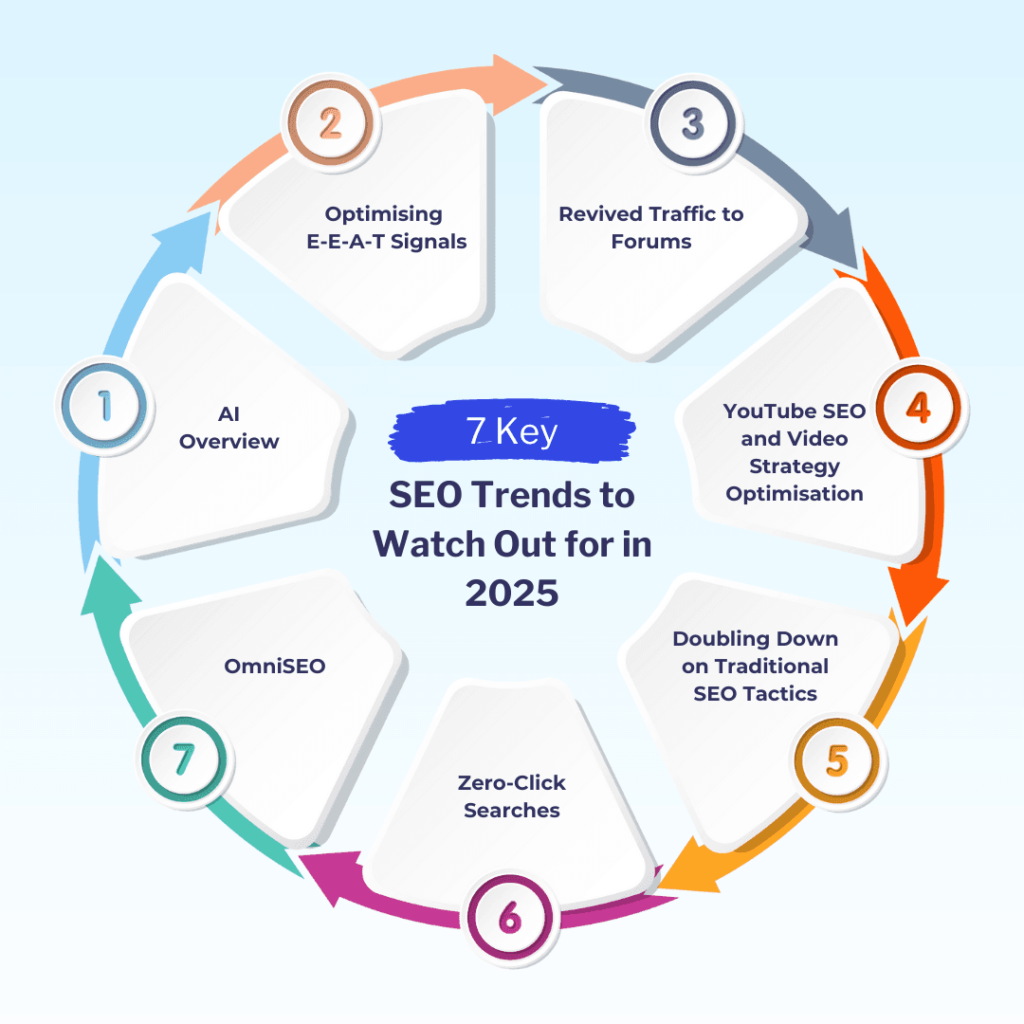
1. AI Overviews and AI Mode Are Reshaping Clicks
Google’s AI Overviews have moved from experiment to everyday feature, and AI Mode now offers a fully conversational search experience. A Pew Research Center analysis of real user behaviour found that about one in five Google searches produced an AI summary, and that users clicked a traditional result in just 8% of visits when a summary appeared, compared with 15% when it didn’t.
That’s a fundamental shift in how organic traffic flows. The right response isn’t panic, it’s adaptation. Being cited inside the AI answer is the new page one.
What to do:
- Open key sections with direct, self-contained answers of 40 to 60 words
- Use question-based headings and FAQ sections
- Add sourced statistics and expert insight
- Strengthen entity signals with Organisation schema and consistent brand information
2. E-E-A-T Signals Build Authority and Trust
Google’s E-E-A-T framework (Experience, Expertise, Authoritativeness and Trustworthiness) matters more than ever, because AI systems need reliable sources to quote. Content from identifiable experts, backed by real experience and credible sources, stands out in a web full of generic AI-written pages.
What to do:
- Add named authors with detailed bios and credentials
- Share first-hand examples, case studies and original data
- Cite authoritative sources and keep facts up to date
- Build consistent expertise across a topic, not just one page
3. Generative Engine Optimisation Becomes Its Own Discipline
Generative engine optimisation (GEO) is the work of getting your brand cited and accurately described in AI-generated answers on Google, ChatGPT, Perplexity, Gemini and Claude. As more searches end inside an AI answer, GEO has become a priority for brands that want to stay visible, and specialist AI search optimization services have grown alongside it.
What to do:
- Track how AI tools answer questions in your category
- Earn mentions in trusted publications, reviews and industry lists
- Keep your brand details consistent everywhere
- Make sure AI search crawlers can access your site
4. YouTube and Video Search Keep Growing
Video dominates online attention, and YouTube is both a search engine in its own right and a frequent source in Google’s results and AI answers. As video becomes central to how people learn and decide, video optimisation is no longer optional.
What to do:
- Write clear, searchable titles and detailed descriptions based on search intent
- Add chapters and accurate captions, so search engines and AI tools can understand your content
- Design eye-catching thumbnails
- Create short-form Shorts alongside long-form videos
- Build engagement through comments, community posts and live streams
YouTube has said tags play only a minor role in discovery, so focus your effort on titles, descriptions and the video itself.
5. Traditional SEO Foundations Matter More, Not Less
AI hasn’t replaced SEO fundamentals. It depends on them. AI tools frequently cite pages that already rank well, so technical health, quality content and authority remain the foundation of AI visibility.
What to do:
- Keep your site technically sound, fast and mobile-friendly
- Target real search intent with helpful, in-depth content
- Build quality backlinks through digital PR and genuine expertise
- Refresh older content so it stays accurate and competitive
6. Zero-Click Searches Become the Norm
More searches now end without a click. SparkToro and Datos found that nearly 60% of Google searches in 2024 ended without a click to the open web, and AI answers are adding to that trend.
Zero-click doesn’t mean zero value. Appearing in a featured snippet, knowledge panel, local pack or AI Overview still builds visibility, trust and brand recall, even when users don’t click straight away.
What to do:
- Answer common questions clearly and concisely
- Use schema markup, such as FAQ, Article, Product and LocalBusiness
- Optimise your Google Business Profile for local searches
- Measure branded searches and conversions, not just clicks
7. Search Everywhere Optimisation
Optimising only for Google is no longer enough. People now search on ChatGPT, Perplexity, Bing, YouTube, Instagram, Amazon and voice assistants. Search everywhere optimisation means building visibility on every platform your audience uses.
What to do:
- Identify where your audience searches and what they ask
- Tailor content to each platform’s format
- Keep your brand message and information consistent everywhere
- Track your visibility on AI tools as well as search engines
Diversification Beyond Google
We’re living through the biggest fragmentation of search in two decades. Google remains dominant, but it’s no longer the only gateway. OpenAI has reported that ChatGPT handles billions of prompts every day, and Perplexity, Gemini, Claude and Microsoft Copilot are all changing how people find answers.
AI tools also draw heavily on forums, reviews and community discussions, such as Reddit, Quora and review platforms. Brands that genuinely take part in these conversations, earn real reviews and appear in trusted industry content are more likely to be recommended.
Broadening your strategy beyond Google makes you less dependent on any single platform. Effective AI search optimization services now include tracking your visibility across ChatGPT, Perplexity and Gemini, not just Google rankings.
What Comes Next for Google
The biggest question for the rest of 2026 is how much of the results page will still be traditional links. At Google I/O 2025, Google said AI Overviews were available in more than 200 countries and territories, and it has since expanded AI Mode to many more markets, including India.
Google is also experimenting with AI agents that can complete tasks for users, such as comparing options or making bookings. As these features grow, clear product information, accurate business details and structured data will matter even more.
Google will keep reshaping search around AI. Staying informed and adapting quickly will help your business benefit, rather than fall behind.
Rethinking Content Strategy for an AI-Driven World
The days of publishing repetitive, keyword-filled articles are over. Search engines and AI tools now reward high-quality, engaging and genuinely informative content written for real people.
Multimedia takes centre stage. Videos, podcasts, images, infographics and interactive tools help explain complex topics, show your culture and reach audiences that text alone misses. As AI systems get better at understanding images, video and audio, multimedia content will play an even bigger role in search visibility.
Personalisation and hyper-localisation. AI-powered search increasingly tailors results to each person’s location, preferences and history. Businesses need accurate local listings, location-specific content and content that speaks to clearly defined audience segments.
The Ethics of AI and Building Trust
AI-generated content is now everywhere, and the risks of misinformation and manipulation are real. Trust is becoming a competitive advantage.
- Be transparent about how you use AI in content and customer communication
- Keep humans accountable for accuracy, tone and final approval
- Fact-check everything, especially statistics and claims
- Watch the rules: India’s government has proposed requirements for labelling synthetically generated content, and similar rules are emerging worldwide
Getting this right protects your brand’s credibility and your relationship with your audience.
How to Measure AI Search Visibility
- AI citations: test priority questions monthly in ChatGPT, Perplexity, Gemini and Google AI Mode
- AI referral traffic: track sessions from AI platforms in GA4
- Search Console: watch impressions and clicks, since AI Overview and AI Mode data is included in the Performance report
- Branded search: rising searches for your brand name show growing awareness
- Brand mentions: track mentions across the web with tools such as Brand24 or Semrush
What to Expect in 2027
- More AI agents completing searches and tasks for users
- Greater fragmentation across AI assistants, social search and marketplaces
- Rising value of trust signals, such as expertise, reviews and brand reputation
- More regulation around AI content, data and transparency
- Closer links between brand and SEO, as AI tools favour recognised, well-described brands
Frequently Asked Questions
How will AI change SEO?
AI is changing how search engines understand content and how results are presented. More answers now appear directly in AI summaries, which means brands must structure content for extraction, demonstrate real expertise and build visibility across AI tools as well as traditional search results.
Is SEO dead because of AI?
No. SEO is evolving, not dying. AI tools often rely on pages that already rank well, so strong SEO remains the foundation for AI visibility. What’s changing is the goal: being cited in AI answers matters alongside ranking in traditional results.
What is AI SEO?
AI SEO has two meanings. It can mean using AI tools to improve SEO work, such as research, content drafting and analysis. It also means optimising content so AI-powered search engines and assistants understand, trust and cite it.
How do I optimise for Google AI Overviews?
Answer questions directly near the top of each section, use clear question-based headings, add FAQ and Article schema, cite reliable sources, show expertise with named authors and keep content up to date. Strong traditional rankings also improve your chances of being cited.
What does an AI SEO agency do?
An AI SEO agency combines traditional SEO with optimisation for AI search. It audits how AI tools describe your brand, restructures content for AI citations, implements schema, builds authority through digital PR and tracks visibility across Google, ChatGPT, Perplexity and Gemini.
How do I choose the best SEO company in Mumbai for AI search?
Look for an agency that can show results in both traditional rankings and AI visibility, explains its process clearly, reports on AI citations and referral traffic and has experience in your industry. The best SEO company in Mumbai for AI search will be honest about what it can and can’t guarantee.
Conclusion: The Future of SEO
SEO in 2026 is being reshaped by AI, machine learning and multimedia content. Gartner predicted in 2025 that 40% of enterprise applications would include task-specific AI agents by the end of 2026, up from less than 5% in 2025, and search behaviour is changing just as quickly.
The AI SEO trends defining 2026 reward brands that create genuinely useful content, structure it for AI extraction and build visibility across every platform their audience uses. Staying flexible, focused and committed to quality is the best way to thrive.
Get Ahead of the Curve With City & Talent
The future of search moves fast, and keeping up means adapting continuously.
City & Talent is a Mumbai-based digital marketing agency, with teams in Delhi and Dubai, helping businesses stay visible across Google, ChatGPT, Perplexity and Gemini. Our team combines deep SEO expertise with AI search optimisation and generative engine optimisation, so your brand is found and recommended wherever your customers search.
If you’re looking for the best SEO company in Mumbai to prepare your brand for AI search, get in touch with our team.