
The digital marketing landscape is experiencing an unprecedented transformation, and at the heart of this revolution lies a fundamental question: What is the future of SEO? As artificial intelligence continues to evolve at breakneck speed, search engine optimisation is undergoing its most significant metamorphosis since Google’s inception.
Understanding how AI is changing SEO isn’t just about staying current with industry trends—it’s about survival in an increasingly competitive digital ecosystem. The tools, techniques, and strategies that defined successful SEO campaigns just a few years ago are rapidly becoming obsolete, replaced by sophisticated AI-driven approaches that promise greater efficiency, accuracy, and results.
This comprehensive exploration delves into the profound ways artificial intelligence is reshaping SEO, from automated content creation to predictive analytics, and reveals what marketers must do to thrive in this brave new world of AI-powered digital marketing.
The Current State of AI in SEO
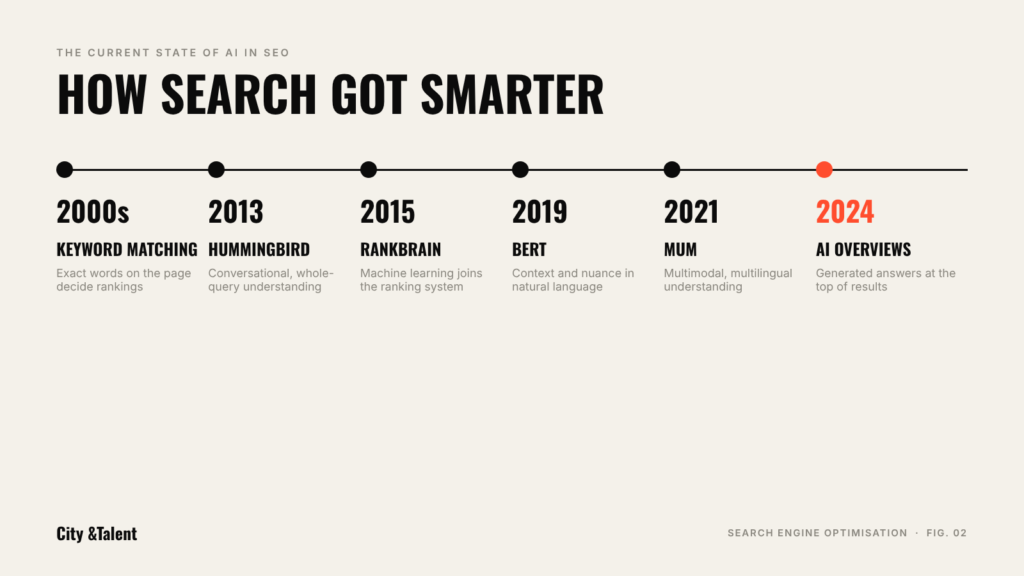
Artificial intelligence in SEO has evolved from an experimental novelty to a vital component of the SEO toolkit. Today’s AI SEO tools leverage machine learning algorithms to analyse vast datasets, identify patterns, and make predictions that would be impossible for human analysts to process manually.
Google’s AI algorithms, including RankBrain, BERT, and MUM, have fundamentally altered how search engines understand and rank content. These sophisticated systems no longer rely solely on keyword matching but instead comprehend context, intent, and semantic relationships between concepts.
AI content optimisation tools now assist marketers in creating more targeted, relevant content by analysing search intent, competitor strategies, and user behaviour patterns. This technological advancement represents a significant shift from manual, intuition-based SEO to data-driven, algorithmically-informed strategies.
The integration of natural language processing in search has made conversational SEO increasingly crucial as search engines become better at understanding and responding to human-like queries. This evolution has a direct impact on how AI is changing SEO practices across all industries.
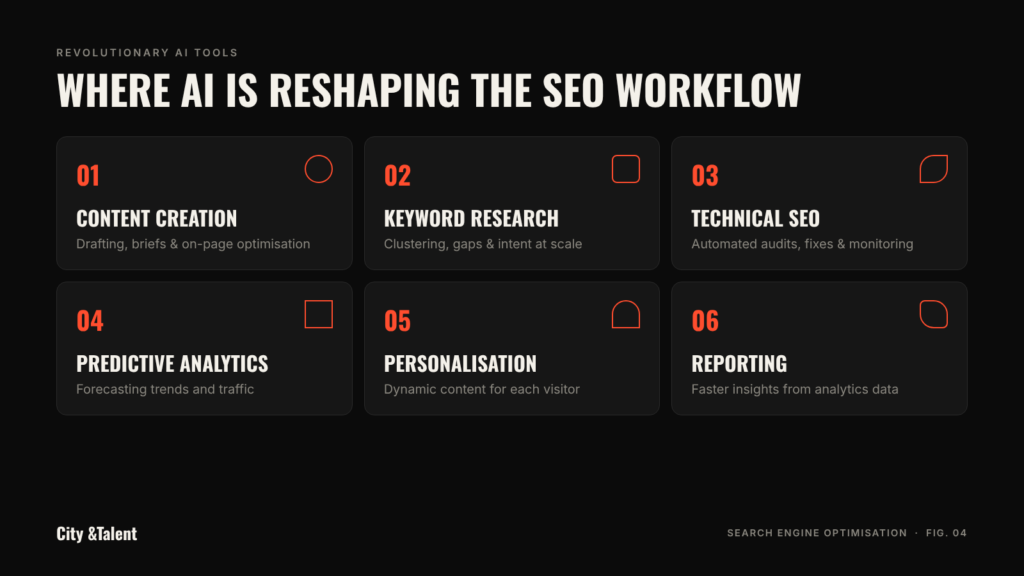
Revolutionary AI Tools Transforming SEO
Content Creation and Optimisation
AI content generation tools have revolutionised how marketers approach content creation, offering the ability to produce high-quality, SEO-optimised content at an unprecedented scale. These platforms utilise generative AI to create articles, meta descriptions, and even entire content strategies based on keyword research and competitor analysis.
Content optimisation AI examines existing content and suggests improvements for semantic SEO, readability, and search engine rankings. These tools identify gaps in content coverage, suggest related topics, and recommend structural enhancements that align with Google algorithm updates.
AI writing assistants now offer real-time suggestions for improving content relevance, readability, and SEO performance. They analyse factors such as keyword density, topical authority, and user engagement metrics to provide actionable recommendations.
Advanced Keyword Research and Analysis
AI keyword research tools have transformed how marketers identify and prioritise target keywords. These platforms analyse search patterns, competition analysis, and search volume trends to uncover opportunities that traditional keyword tools might miss.
Predictive keyword analysis uses historical data and machine learning to forecast which keywords are likely to become more competitive or valuable in the future. This capability allows marketers to stay ahead of trends and secure advantageous positions before markets become saturated.
Voice search optimisation has become increasingly important as AI voice assistants reshape how users interact with search engines. Understanding conversational search patterns and long-tail keywords is crucial for capturing this growing market segment.
Technical SEO Automation
AI-powered technical SEO tools automate many time-consuming tasks, from site audits to website performance optimisation. These systems can identify technical issues, suggest fixes, and even implement specific improvements automatically.
Automated SEO auditing tools analyse websites for crawl errors, page speed issues, mobile responsiveness, and other technical factors that impact search rankings. This automation allows SEO professionals to focus on strategic initiatives rather than routine maintenance tasks.
AI website optimisation platforms continuously monitor site performance and make real-time adjustments to improve user experience and search engine visibility. This proactive approach helps maintain optimal performance without constant manual intervention.
How AI is Changing SEO Strategies
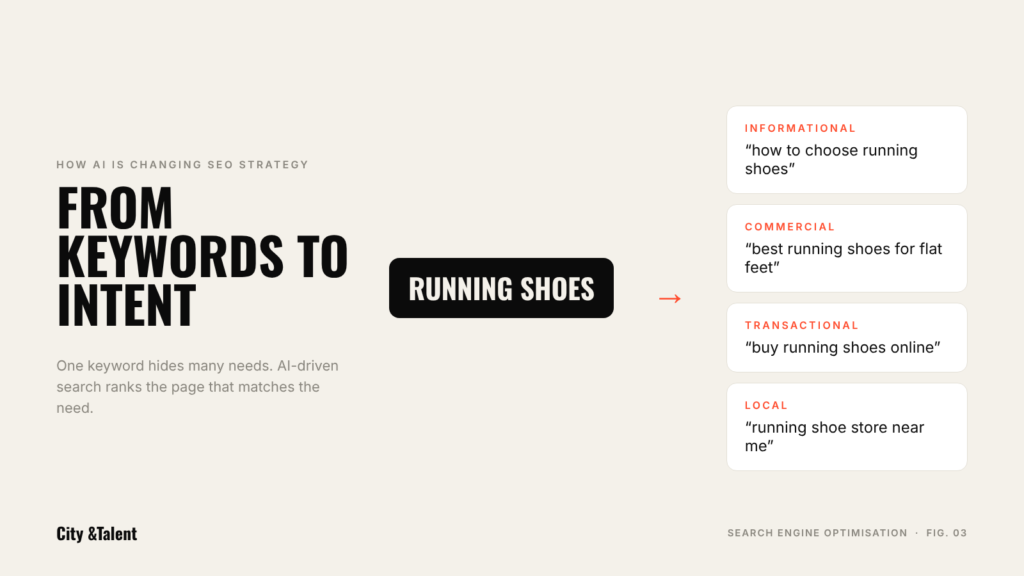
From Keywords to Intent
Search intent optimisation has become paramount as AI search algorithms become more sophisticated at understanding user needs. Rather than focusing solely on specific keywords, successful SEO strategies now prioritise understanding and addressing the underlying intent behind searches.
Semantic search optimisation requires creating content that addresses related concepts, synonyms, and contextual variations of target keywords. AI content analysis tools help identify these semantic relationships, ensuring comprehensive coverage of topics.
User journey mapping powered by AI provides insights into how users interact with content across multiple touchpoints, enabling more strategic content planning and conversion optimisation.
Personalisation and Dynamic Content
AI-powered personalisation is reshaping how websites deliver content to users. Dynamic content optimisation allows sites to present different content variations based on user behaviour, search history, and demographic information.
Personalised SEO strategies leverage AI to understand individual user preferences and tailor content experiences accordingly. This approach improves user engagement metrics and can positively impact search rankings.
Behavioural analysis AI provides deeper insights into how users interact with content, enabling more effective content strategy development and website optimisation.
Predictive Analytics and Forecasting
SEO forecasting powered by artificial intelligence enables marketers to predict future trends, seasonal fluctuations, and competitive changes with remarkable accuracy. This capability allows for more strategic resource allocation and effective campaign planning.
Predictive content marketing uses AI to identify topics that are likely to gain popularity, helping content creators stay ahead of trends and capture early search traffic.
Competition prediction tools analyse competitor behaviour patterns and predict likely strategic moves, enabling proactive counter-strategies and market positioning.
The Impact on Traditional SEO Practices
Link Building Evolution
AI link-building tools have transformed how marketers approach link acquisition and relationship building. These platforms identify high-quality link opportunities, analyse backlink quality, and even assist in outreach automation.
Link quality assessment powered by AI provides more nuanced evaluations of potential linking partners, considering factors beyond simple domain authority metrics. This sophisticated analysis helps avoid Google penalties and focuses efforts on genuinely valuable connections.
Automated outreach systems personalise communication at scale whilst maintaining authenticity, dramatically improving response rates and link acquisition efficiency.
Local SEO Transformation
Local SEO AI tools have revolutionised how businesses approach geographic targeting and local search optimisation. These systems analyse local search patterns, competitor positioning, and Google My Business optimisation opportunities.
Location-based content optimisation utilises AI to comprehend local search intent and craft content that resonates with geographically specific audiences. This approach improves visibility in local search results and drives more qualified traffic.
Review management AI helps businesses monitor, respond to, and leverage customer reviews more effectively, improving local search rankings and online reputation.
Analytics and Reporting Revolution
AI analytics platforms offer more in-depth insights into SEO performance by correlating multiple data sources and identifying patterns that may elude human analysis. These tools provide automated reporting and performance insights, enabling more informed decision-making.
Conversion tracking AI follows user journeys across multiple touchpoints, providing clearer attribution models and helping optimise actual business outcomes rather than vanity metrics.
ROI calculation powered by artificial intelligence provides more accurate assessments of SEO campaign effectiveness by considering complex attribution models and long-term value metrics.
Challenges and Opportunities
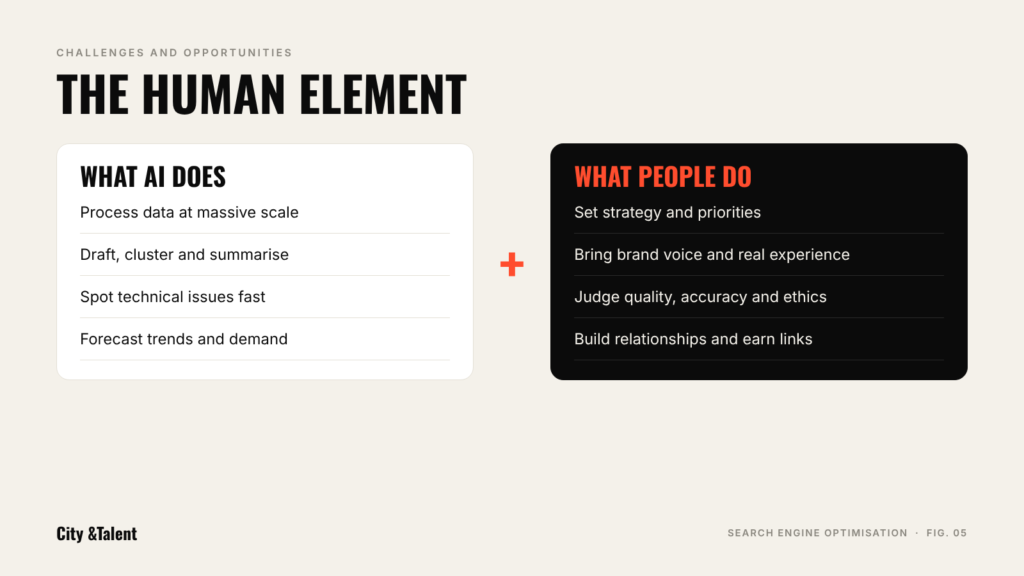
The Human Element
Whilst AI automation offers tremendous efficiency gains, human creativity and strategic thinking remain irreplaceable. Successful SEO strategies increasingly combine AI capabilities with human insight and expertise.
AI limitations include potential biases in training data, inability to understand nuanced brand voice, and challenges with truly creative problem-solving. Human oversight remains essential for quality control and strategic direction.
Skill development for SEO professionals must now include understanding AI tools, interpreting AI-generated insights, and knowing when human intervention is necessary.
Ethical Considerations
AI ethics in SEO presents new challenges around content authenticity, user privacy, and fair competition. Marketers must navigate these considerations while leveraging AI’s capabilities responsibly.
Content authenticity becomes more complex as AI-generated content becomes more sophisticated. Maintaining genuine value and avoiding duplicate content issues requires careful strategy and oversight.
Data privacy concerns intersect with AI’s need for user data to provide personalised experiences. Balancing personalisation with privacy protection is increasingly important for sustainable SEO strategies.
Preparing for the Future
Essential Skills and Tools
AI literacy is becoming as crucial as traditional SEO knowledge. Professionals must understand how to work with AI tools, interpret their outputs, and integrate AI insights into broader marketing strategies.
Continuous learning is essential as AI technology continues to evolve rapidly. Staying current with new tools, techniques, and best practices requires ongoing education and experimentation.Tool integration strategies help maximise the value of AI investments by ensuring different platforms work together effectively and provide comprehensive insights.
Strategic Adaptations
Future-proofing SEO strategies requires embracing AI while maintaining a focus on fundamental principles, such as user value, content quality, and technical excellence.
Agile methodology becomes increasingly crucial as AI enables faster testing, iteration, and optimisation cycles. Organisations must develop capabilities to adapt quickly to new opportunities and challenges.
Cross-functional collaboration between SEO, content, development, and data science teams becomes crucial for leveraging AI effectively across all aspects of digital marketing.
What is the future of SEO?
The future of SEO will likely see even greater integration of artificial intelligence, with automated SEO handling routine tasks whilst humans focus on strategy, creativity, and relationship building.
Emerging technologies such as quantum computing, advanced natural language generation, and augmented reality will create new opportunities and challenges for SEO professionals.
The search evolution continues as voice search, visual search, and AI chatbots transform how users discover and interact with information. SEO strategies must adapt to these shifting behaviours and technologies.
Industry consolidation may occur as smaller SEO tools are acquired by larger AI platforms, resulting in more comprehensive yet potentially more expensive solutions.
Embracing the AI-Driven SEO Revolution
Understanding what the future of SEO is requires recognising that artificial intelligence isn’t replacing human expertise—it’s amplifying it. The most successful SEO strategies will combine AI’s analytical power with human creativity, strategic thinking, and relationship-building Capabilities.
The impact of AI on SEO extends far beyond simple automation. It’s creating opportunities for more sophisticated analysis, personalised experiences, and predictive strategies that were previously impossible. However, success in this new landscape requires continuous learning, ethical consideration, and strategic thinking.
The organisations that thrive in this AI-driven future will be those that embrace these technologies whilst maintaining a focus on delivering genuine value to users. AI tools provide unprecedented capabilities, but they’re most effective when guided by experienced professionals who understand both technology and human behaviour.
As we move forward, the question isn’t whether AI will transform SEO—it’s how quickly and effectively organisations can adapt to leverage these powerful new capabilities. The future belongs to those who can successfully merge artificial intelligence with human insight to create SEO strategies that are both technologically advanced and fundamentally user-focused.
At City &Talent, we’re at the forefront of this AI revolution, helping businesses navigate the complex intersection of artificial intelligence and search engine optimisation. Our expert team combines cutting-edge AI tools with proven SEO strategies to deliver results that drive real business growth in this rapidly evolving digital landscape.